AI Search: The Difference Between SEO, AEO, and GEO That Will Define Your Content Strategy in 2026
Complete, practical guide to SEO, AEO (Answer Engine Optimization), and GEO (Generative Engine Optimization). Understand how each works, how to measure results, and why your strategy needs to cover all three to be relevant in 2026.


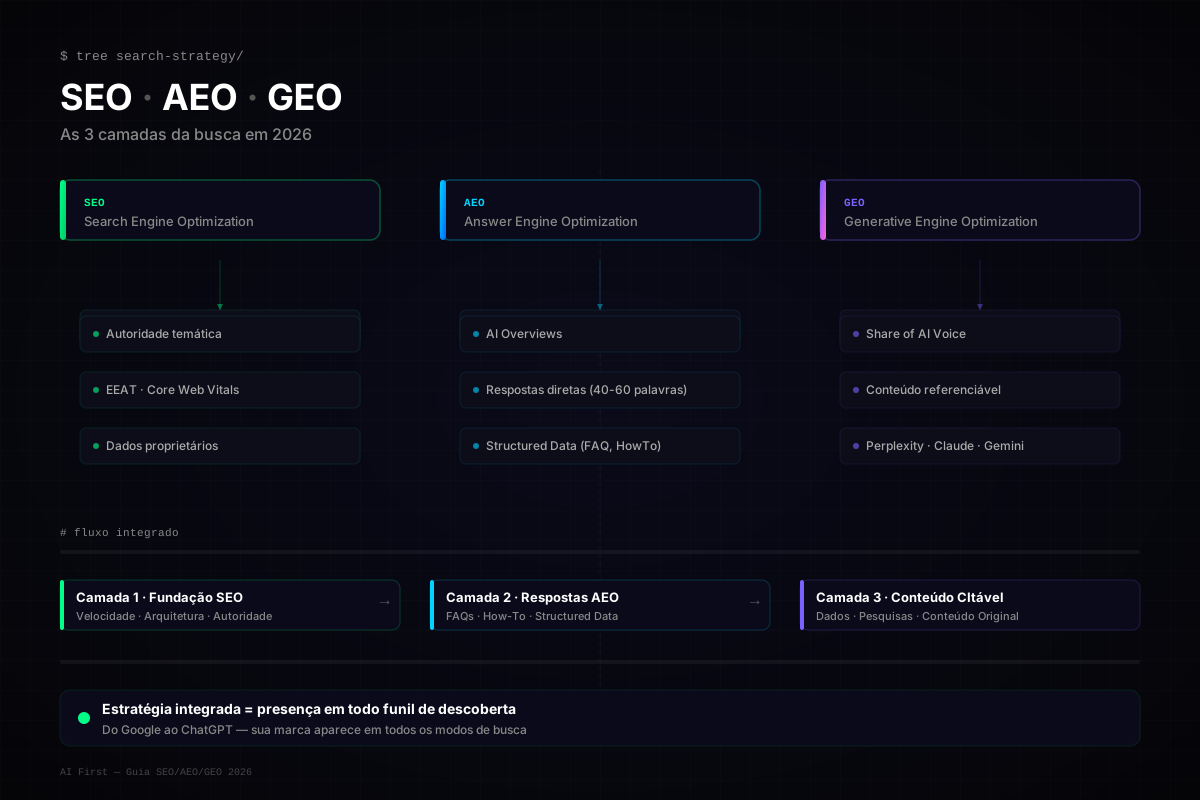
Search Is No Longer One Thing
In 2026, the term "Search Engine Optimization" has become an umbrella covering three distinct disciplines, each with its own mechanisms, metrics, and strategies:
- SEO (Search Engine Optimization): Appearing in traditional Google results
- AEO (Answer Engine Optimization): Being extracted as an answer in featured boxes and short AI responses
- GEO (Generative Engine Optimization): Being cited in long-form responses generated by ChatGPT, Perplexity, Gemini, and Claude
Ignoring any of the three means being invisible to a growing portion of your audience.
SEO: The Foundation That Didn't Die
Traditional SEO didn't die — but its function changed. Instead of being the main traffic driver, SEO today is:
- The credibility foundation that the other two search modes use to evaluate your site
- The path to high-intent traffic (purchases, signups, registrations)
- The target of AI Overviews, which cannibalize clicks but generate brand awareness
What Works in SEO in 2026
- Topical authority: Sites recognized as references in a specific topic rank better than generalist sites
- Original content with data: Original research, proprietary data, and citations from authoritative sources
- User experience: Core Web Vitals remain a prerequisite, not a differentiator
- Signaled EEAT: Clear About pages, identified authors, citations from verifiable sources
SEO Metrics
| Metric | What it measures | 2026 Benchmark |
|---|---|---|
| Organic CTR | % of clicks in searches | 2-5% (position 1) |
| Average position | Ranking for target keywords | Top 3 for head terms |
| Organic traffic | Visitors from search | Month-over-month growth |
| Organic conversion | % that becomes lead/sale | > site average |
AEO: The New Visibility Layer
AEO isn't about clicks — it's about being the answer. When Google shows an AI Overview, a featured snippet, or a "People Also Ask" answer, it's extracting content from your site and displaying it without a click.
What AEO is for
For the user who wants a quick answer without navigating: "What is the capital of France?", "What is SEO?", "How to do X in 3 steps?"
How to optimize for AEO
Ideal structure for AEO:

1. Clear question as heading (H2)
2. Direct answer in 40-60 words (first paragraph)
3. List or table when applicable
4. Structured data: FAQ, HowTo, QAPage
5. Additional context below (for those who want to go deeper)
Practical example:
## What is Answer Engine Optimization?

Answer Engine Optimization (AEO) is the practice of structuring content
so that it is extracted and displayed as a direct answer by
search engines that prioritize answers over links —
including Google AI Overviews, featured snippets, and voice
assistants like Google Assistant and Siri.
AEO Metrics
| Metric | What it measures |
|---|---|
| AI Overview impression | How often your content appears in AI responses |
| Featured Snippet rate | % of searches with your content featured |
| Share of Voice (AEO) | % of appearances vs. competitors |
| Zero-click value | Brand value generated without direct clicks |
GEO: The Final Frontier
GEO is the practice of being cited as a source by generative models — ChatGPT, Perplexity, Claude, Gemini, and Copilot.
Unlike SEO (which seeks clicks) and AEO (which seeks extraction), GEO seeks citation with attribution:
"According to [your site/article], the trend is that..."
Why GEO matters
Users are trusting AI recommendations. A 2026 Gartner survey shows that 47% of users aged 18-35 have already made purchase decisions based on ChatGPT or Perplexity recommendations — without clicking any links.
If your brand isn't cited, you don't exist in this new funnel.
How to get cited by AIs
- Produce referenceable content: Articles with data, statistics, citations, and sources
- Clear structure with descriptive headings: AI models use headings to understand structure
- Be cited by others: Citations on authoritative sites increase your likelihood of being cited by AIs
- Stay updated: AIs prefer recent sources for factual information
- Use clear, objective language: Excessive jargon reduces citation probability
GEO Metrics
| Metric | What it measures |
|---|---|
| AI Citation Rate | How often your site is cited in AI responses |
| Share of AI Voice | % of citations vs. competitors in target queries |
| Citation Accuracy | Whether the AI cited your information correctly |
| Referral Traffic from AI | Clicks coming from ChatGPT/Perplexity |
Integrated Strategy: The 3-Layer Framework
To be present across all search modes, your strategy needs three layers:
Layer 1: SEO Foundation
- Technically flawless site (speed, mobile, indexing)
- Clear information architecture
- Authoritative content for head and long-tail terms
Layer 2: AEO Answers
- FAQ pages structured by topic
- How-to guides with numbered steps
- Glossaries and short definitions
- Structured data implemented (FAQ, HowTo, QAPage)
Layer 3: Citable Content (GEO)
- Original research with proprietary data
- Well-founded opinion articles
- Complete guides with citations and references
- Regularly updated content
Conclusion
SEO, AEO, and GEO aren't competitors — they are complementary battlefields in the same war for digital attention.
In 2026, a brand that only does SEO is competing with one hand tied behind its back. Those covering all three layers are present across the entire discovery funnel — from the user searching on Google to the user asking ChatGPT.
The professional who understands this triad isn't an "SEO specialist." They are a search strategist for the generative AI era.
Marcos Luciano is Senior Media Buyer, AI & SEO Specialist at V4 Company. He writes daily about artificial intelligence, AI system architecture, and the technology market. Follow on LinkedIn.
Get the next articles
Subscribe to receive new articles about AI, architecture, and market news directly in your inbox.
No spam. Unsubscribe anytime. Your data will not be shared.
300x250 / In-Article
